Just Purification

From Process Intensification to Continuous Manufacturing (CM) Deployment
Continuous Manufacturing turnkey solution for Clinical manufacturing is now a reality
PROCESS INTENSIFICATION (PI)CONTINUOUS MANUFACTURING (CM)
2/21/20263 min read
The Expertise Behind Lisure’s Clinical Manufacturing Solutions
In terms of biopharmaceutical manufacturing technology, many organizations understand the benefits of process intensification and continuous processing but it is extremely challenging for most of them to actually translate those concepts into validated, production-ready systems.
That is where Lisure has built its expertise.
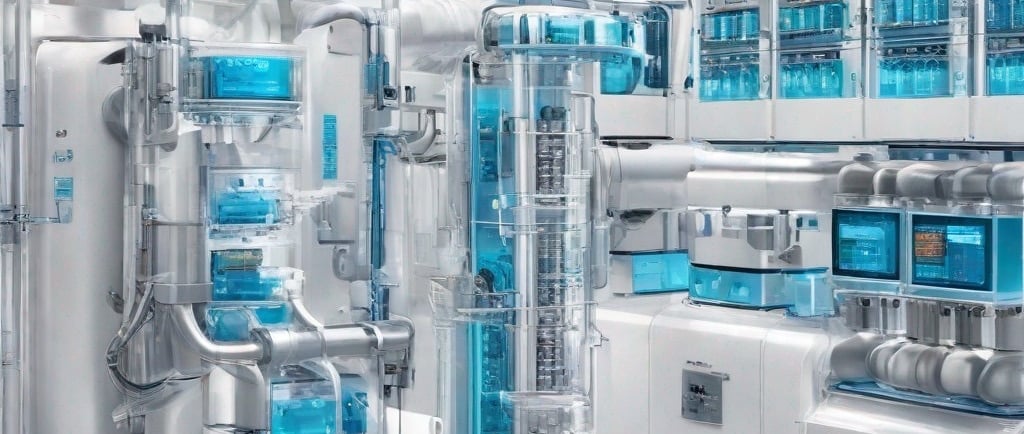
Over the past years, Lisure has focused on one core objective: redesigning downstream bioprocessing so it is faster, smaller, more efficient, and easier to deploy. This has led to integrated platforms such as LetsGo 3.1, a turnkey clinical manufacturing solution built on continuous processing principles.
The foundation is not a single product. It is a layered capability across hardware design, system integration, process intensification, automation/software, and deployable manufacturing architecture.
Deep Expertise in Process Intensification
Process intensification is not simply about making equipment smaller. It requires rethinking how unit operations interact, how material flows through the system, and how performance is measured.
Lisure’s work in this area focuses on:
Increasing throughput per unit footprint
Reducing resin volumes and column sizes without compromising performance
Minimizing hold times between unit operations
Enabling steady-state operation rather than batch cycling
For example, SSTFF for direct loading of high salt sample on chromatography column can reduce total processing time and equipment footprint significantly while maintaining product quality and yield.
Process intensification at this level requires a strong understanding of flow system, fluid dynamics, control systems, and bioprocess integration. It is not a bolt-on optimization. It is built into the system design from the start.
Integrated Process Design, Not Equipment Assembly
One of the persistent challenges in biomanufacturing is fragmentation. Chromatography skids, buffer prep systems, filtration units, and automation layers are often sourced separately and integrated later.
Lisure approaches design differently.
Integrated process design means:
Unit operations engineered to function as one continuous flow path
Automation and control logic developed in parallel with hardware
Buffer preparation aligned with downstream consumption rates
System boundaries defined to simplify compliance and validation
This systems-level thinking is what enables continuous downstream processing with constant feed-in and constant product-out.
Instead of optimizing each step independently, Lisure optimizes the entire production train.
Continuous Processing as a Practical Manufacturing Strategy
Continuous processing has long been recognized for its potential to improve consistency and reduce footprint. However, many companies hesitate to adopt it due to perceived development complexity and regulatory uncertainty.
Lisure’s expertise lies in implementing continuous processing in a way that fits existing development programs.
Key elements include:
Translating batch processes into continuous operation without re-development
Designing steady-state control strategies supported by DCS and S88 batch management
Incorporating continuous inline buffer dilution to eliminate large batch buffer preparation
This approach allows organizations to adopt continuous manufacturing at the clinical stage rather than postponing it until commercial scale.
Continuous processing becomes practical, not experimental.
Turnkey Clinical Manufacturing: From Concept to Deployment
All of this expertise converges in LetsGo 3.1, Lisure’s turnkey clinical manufacturing platform.
LetsGo 3.1 is:
A fully enclosed, cGMP-compliant downstream production line
Built on modular M++ architecture
Designed for one-click automated operation
Deployable in approximately six months
Scalable from 500 L to 4000 L clinical capacity
Expandable through parallel system deployment
Crucially, it does not require extensive site construction or CIP utilities. The system arrives ready to integrate, minimizing infrastructure burden.
Technology transfer is structured as replication rather than redesign. The same architecture can scale toward commercial manufacturing, reducing late-stage risk.
Experience That Connects Engineering and Strategy
What distinguishes Lisure’s approach is the connection between engineering depth and strategic awareness.
Process intensification increases output while lowering operating costs.
Integrated design reduces cycle time and footprint.
Continuous processing makes unavailable time available for production.
Turnkey deployment compresses capital exposure and accelerates timelines.
These are not isolated benefits. They reinforce each other and translate to significant business benefits.
For organizations responsible for CMC strategy, MSAT execution, and clinical manufacturing delivery, the value lies not just in new equipment but in a restructured manufacturing model.
Lisure’s experience across intensification, integration, and deployment positions it to move continuous bioprocessing from theory into operational reality.
With platforms like LetsGo 3.1, that reality is already in motion.