Just Purification

Beyond Pilot Equipment: A Process Design Platform for Continuous Manufacturing (CM) and PI
Scientists optimize chemistry/purification/product quality. Equipment engineers design processing systems. Automation engineers develop robust control. Manufacturing engineers build operations. A process-design platform is a place for them to converge early and it is economic/business-wise significant.
CONTINUOUS MANUFACTURING (CM)TECHNOLOGY TRANSFEREQUIPMENT DESIGNPROCESS INTENSIFICATION (PI)
9/14/20267 min read
Continuous manufacturing is often approached as an equipment problem: make individual unit operations continuous, connect them together, and a continuous manufacturing process will emerge.
That approach has produced important innovations. But it also misses a more fundamental challenge.
Continuous manufacturing is a process design problem.
Once individual operations are connected, engineers are no longer designing chromatography, filtration, TFF, buffer preparation, or other operations independently. They are designing a manufacturing system in which material flow, processing time, equipment states, intermediate capacity, automation, disturbances, quality control, and manufacturing information must work together.
This creates a need for something that conventional process-development equipment was never intended to provide:
A proof-of-concept platform for designing the manufacturing architecture itself.
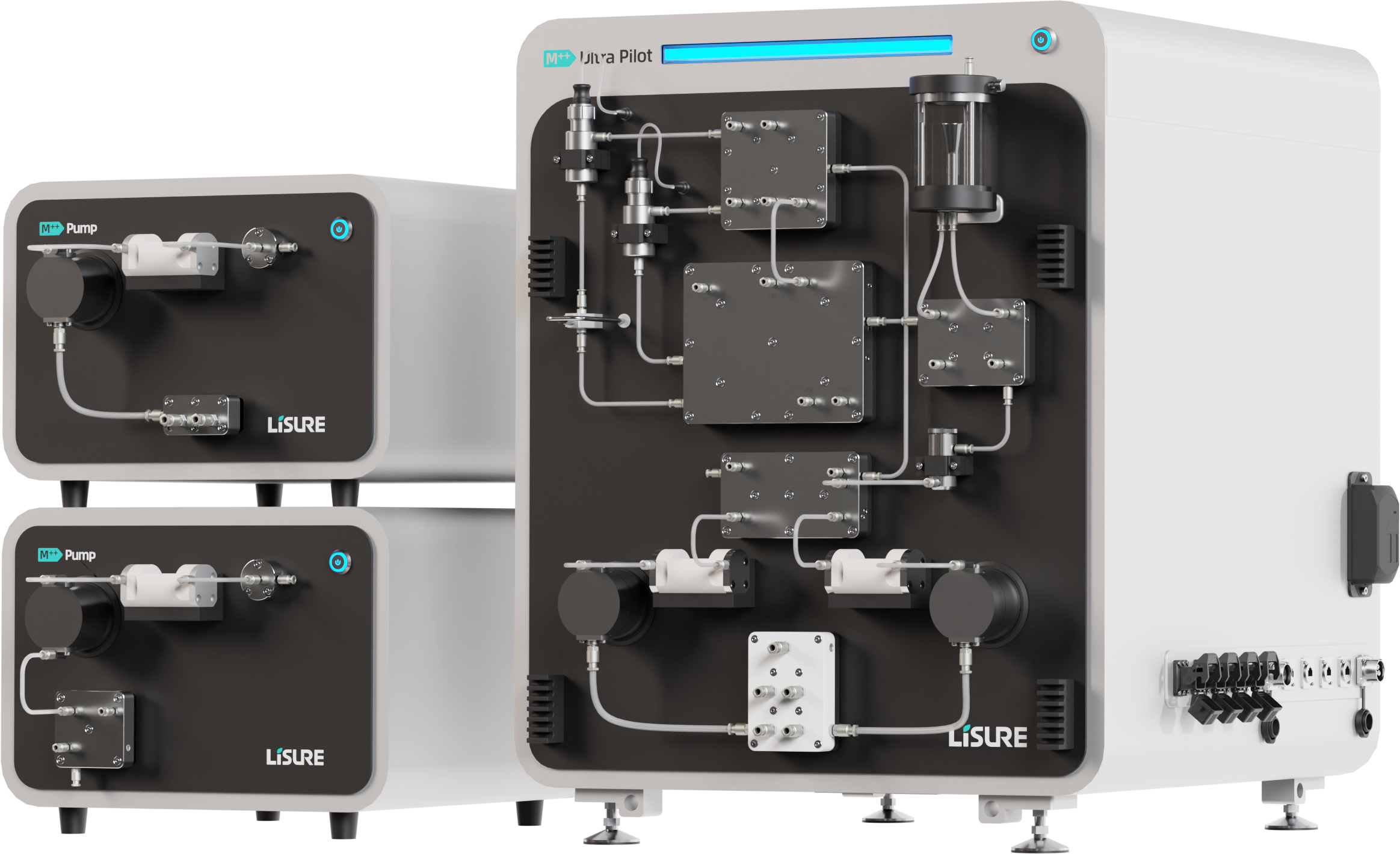
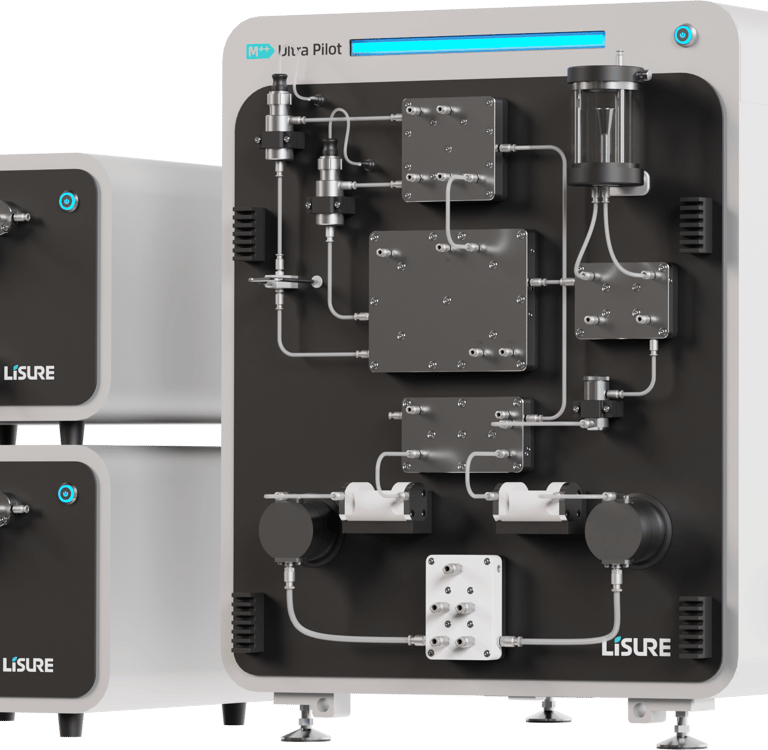
Lisure developed the M++ UltraPilot platform around this idea.
The Missing Layer Between Process Development and Manufacturing
Traditional process development is exceptionally good at answering questions about the process itself.
Which resin should be used? What loading capacity is appropriate? What membrane area is required? What operating pressure or flux should be maintained? What buffer conditions provide the required separation?
These are essential questions.
But successful development of individual unit operations does not automatically answer a different set of questions:
How should these operations work together as one manufacturing process?
For a connected or continuous process, engineers must consider questions such as:
How should material move from one operation to another?
How should time-dependent operations interact with continuous material flow?
What happens when processing times differ among operations?
How should equipment states be coordinated?
Where is intermediate material held, if necessary?
How should upstream and downstream operations respond to one another?
What happens when one operation is temporarily delayed?
How should process automation manage the overall sequence?
How will the resulting process eventually interact with the manufacturing environment?
These are not simply process-development questions.
They are process design questions.
And waiting until commercial equipment or a manufacturing facility is being designed to answer them is unnecessarily expensive.
A POC Platform Should Prove Architecture, Not Just Performance
A conventional pilot skid is often a smaller version of a production system. Its primary purpose is to demonstrate or characterize a particular unit operation.
A continuous manufacturing POC platform should have a different objective.
It should provide an engineering environment in which scientists and engineers can explore different manufacturing architectures.
A chromatography operation may first be evaluated conventionally. It may then become part of a connected process. Multiple operating states may be introduced. Material flow may be reorganized. The automation sequence may change. The same process may ultimately become part of a fully continuous manufacturing configuration.
The important question is therefore no longer simply:
“Does the unit operation work?”
It becomes:
“How should the unit operations be architected, connected, controlled and transferred so that the manufacturing process works as one system?”
That is the design problem M++ is intended to address.
One Platform, Many Process Configurations
A useful process-design platform should not force scientists to commit prematurely to one manufacturing architecture.
The opposite should be true.
The platform should make it practical to explore multiple configurations while the process is still inexpensive and relatively easy to change.
M++ was therefore conceived as a configurable pilot-scale environment capable of supporting conventional unit operations as well as more highly integrated processing configurations.
Potential operations include chromatography, normal-flow filtration, tangential-flow filtration, inline processing and other downstream operations. Individual operations can be studied independently, but the greater value comes from configuring them into increasingly integrated process architectures.
This creates a progression:
Individual Unit Operation
Integrated Operations
Connected Processing
Continuous Manufacturing
The same engineering environment can therefore support the transition from understanding an individual operation to understanding how an entire manufacturing process should function.
The internal implementation that enables this flexibility is less important to the user than the engineering capability it creates:
The process configuration can become a design variable.
Continuous Manufacturing Does Not Require Every Operation to Become Inherently Continuous
This is an important distinction in Lisure's Process Design Framework (PDF).
Many pharmaceutical operations are naturally time-dependent. Chromatography includes loading, washing, elution, regeneration and equilibration. Filters may require replacement. Vessels perform fill, process, transfer and preparation functions.
Trying to eliminate time dependency from every individual operation can create unnecessary process-development complexity.
L3.1 Continuous Manufacturing takes a different approach.
Instead of asking:
How do we make every operation inherently continuous?
the design question becomes:
How do we design time-dependent operations to run continuously at the manufacturing-system boundary?
This seemingly small change in perspective opens a much larger design space.
It means established unit operations do not necessarily need to be reinvented before they can participate in continuous manufacturing.
The challenge moves from inventing a new processing mechanism to designing the architecture around the processing mechanism.
And that is exactly where a configurable POC platform becomes valuable.
Horizontal Integration Is Only Half of the Opportunity
The most obvious role of a CM process-design platform is horizontal integration.
A downstream process may contain:
Capture → Virus Inactivation → Filtration → Polishing → TFF
The POC platform allows engineers to investigate how these operations should connect and operate as a coordinated material-flow system.
But there is another dimension that may ultimately be even more important.
Vertical Integration
A manufacturing process does not stop at the equipment.
Above the physical process is the process automation system, or PAS. Above or interacting with that layer is the manufacturing execution environment, including MES and related manufacturing-information systems.
So the manufacturing architecture also has a vertical dimension:
Manufacturing Execution / Information
Process Automation
Equipment and Process
Material Flow
Historically, these layers are frequently integrated relatively late in a manufacturing project.
That can result in substantial engineering effort devoted to interfaces, execution logic, data relationships, scheduling, material tracking and system integration—sometimes continuing well after the physical manufacturing system is operational.
A process-design platform creates the opportunity to move some of these questions much earlier.
Develop the Automation Architecture with the Process
M++ is built around an industrial process-control environment rather than treating automation as something that will be added after process development.
This distinction matters.
For connected and continuous manufacturing, automation is not simply a mechanism for opening valves and controlling pumps.
Automation is part of the process architecture.
Equipment states, transitions, permissives, material availability, process sequences and interactions among operations can determine whether a connected process actually functions.
A POC platform can therefore allow process scientists and automation engineers to work on the same manufacturing problem much earlier.
Instead of:
Develop Process → Design Equipment → Develop Automation
the workflow can increasingly become:
Design Process + Equipment Architecture + Automation Together
This can substantially change the nature of technology transfer.
From Process Automation to Manufacturing Execution
L3.1 Continuous Manufacturing introduces another important possibility.
In a traditional batch process, manufacturing execution often involves detailed coordination of individual processing steps. Production schedules, work orders, equipment availability and operator actions must collectively move a batch from one operation to the next.
An L3.1 architecture can establish a different division of responsibility.
At a conceptual level:
The higher manufacturing layer determines what to manufacture and how much.
while:
The process automation layer determines how and when the real-time process executes.
The physical L3.1 process can then generate consecutive, identifiable material populations as part of its normal operation.
This creates the possibility of aligning:
Physical Material Boundaries
Process Automation Execution Boundaries
Manufacturing Lot Boundaries
without requiring the MES to reproduce every internal real-time state of the continuous process.
The potential consequence is significant: continuous manufacturing may simplify the PAS–MES relationship rather than make it more complicated.
A POC environment such as M++ provides a place to begin developing and evaluating this manufacturing architecture before commercial implementation.
Move Expensive Decisions Earlier
This may ultimately be the largest economic benefit of the POC approach.
Many engineering decisions become progressively more expensive to change as a project advances.
Consider discovering an architectural problem during:
process development;
pilot-scale proof of concept;
detailed engineering;
automation integration;
FAT;
SAT; or
commercial operation.
The technical issue might be identical.
The cost of correcting it is not.
A configurable POC platform moves important decisions toward the front of the project:
Material-flow architecture
Process integration
Equipment roles
Operating states
Control philosophy
Automation sequences
Manufacturing execution concepts
can all begin to be evaluated before the commercial system is finalized.
The objective is not simply faster experimentation.
It is earlier engineering certainty.
Design Once, Scale by Preserving Architecture
Traditional scale-up frequently focuses on process parameters.
Continuous manufacturing requires us to think about another form of scale-up as well:
architectural scale-up.
A commercial chromatography column may be larger. A TFF system may have greater membrane area. Pumps may provide higher flow rates. Vessels may have greater capacity. Instrument ranges may change.
Those are expected consequences of scale.
But should the fundamental process topology, operating philosophy and automation architecture need to be redesigned every time the physical scale changes?
Ideally, no.
A POC platform should allow engineers to establish an architecture at pilot scale that can be preserved as the process moves toward manufacturing.
Conceptually:
Pilot Process Architecture
Proven Process Logic
Scale-Dependent Parameters Change
Commercial Manufacturing Architecture
This is fundamentally different from using pilot equipment merely to generate scale-up data.
The POC platform becomes part of the technology-transfer methodology.
The Role of M++ in Lisure's Process Design Framework
These concepts provide a useful way to distinguish three related elements of Lisure's approach.
Lisure Process Design Framework (PDF) provides the methodology for designing process intensification and continuous manufacturing.
L3.1 Continuous Manufacturing provides an architecture for converting time-dependent processing operations into a manufacturing system with continuous material-flow boundaries.
M++ UltraPilot provides the engineering environment in which process configurations and manufacturing concepts can be explored and demonstrated before commercial implementation.
In simplified form:
PDF — How We Approach
L3.1 — How We Architect
M++ — Where We Prove
This is why M++ is not simply another pilot skid.
From Process Development to Manufacturing-System Development
The pharmaceutical industry has invested enormous effort in process development.
The next opportunity is to create a more systematic discipline around manufacturing-system development.
Scientists should still optimize chemistry, separation and product quality.
Equipment engineers should still design reliable processing systems.
Automation engineers should still develop robust control.
Manufacturing engineers should still build scalable operations.
But a process-design platform gives these disciplines a place to converge much earlier.
That becomes particularly important as the industry moves toward process intensification, connected processing and continuous manufacturing.
The objective is not simply to connect more equipment.
It is to design a manufacturing architecture in which process, equipment, automation and manufacturing execution are designed to work together from the beginning.
And that leads to a different definition of what a proof-of-concept platform should accomplish:
The purpose of a POC platform is not to build a smaller version of the commercial plant. It is to make the important design decisions before the commercial plant exists.
That is the role Lisure believes M++ can play in the next generation of biopharmaceutical manufacturing.